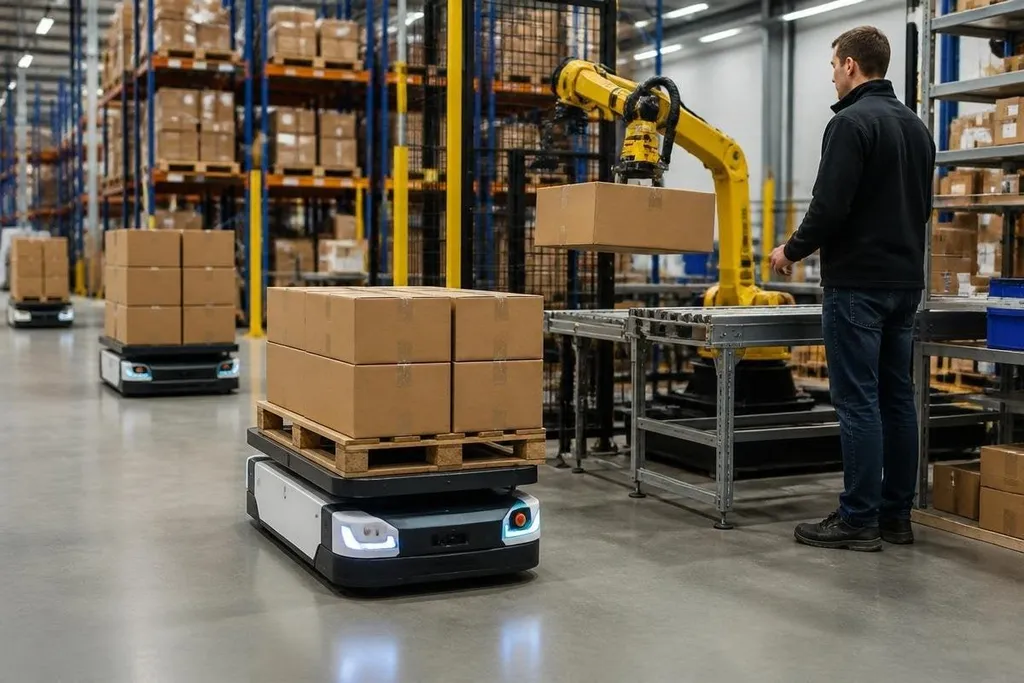
Warehouse robots are moving toward more work, but the next step won't come from a single machine doing everything. It will come from systems that move goods, share information, and hand work back to people when the setting changes.
- Mobile robots will take on more repeat trips between storage and packing areas.
- Robot arms will need better grip control for mixed products.
- People will still handle exceptions that sensors and software can't read safely.
More robots will work as a system
A warehouse robot already needs more than wheels and a motor. It must read its position, avoid people, receive jobs from warehouse management software, and report when a load reaches the right place.
That link to the warehouse management system, or WMS, will shape future deployments. A robot that moves quickly but receives poor stock data can send the wrong tote to packing. Better software can prevent that error before the robot leaves its station.
The same shift will affect robot fleets. One vehicle may carry a tote, another may bring a pallet, and a fixed arm may sort the contents.
Fleet software will assign each job based on location, load, battery state, and traffic. The useful measure will be completed orders, not the number of robots on the floor.
Grippers will face the hard work
Moving a standard box is easier than picking a soft bag, a shiny package, or an item partly hidden under another product. Those tasks need cameras, force sensors, and grippers that can change how they hold an object.
A gripper must sense when an item slips, then adjust its pressure without crushing it. That sounds small, but a warehouse may contain thousands of product shapes. The machine must also spot labels and barcodes at different angles, often under uneven light.
Robot arms will gain value as their task list grows, but the limits will stay visible. A system trained on fixed shelves and known products may need a person when packaging changes or a new item arrives.
Safety will decide where robots can work
Mobile robots share floors with workers, forklifts, and other vehicles. LiDAR, cameras, warning lights, speed limits, and stop controls all matter because a warehouse changes during every shift.
The robot must react to a person stepping into its path. It also needs a safe response when a pallet blocks the planned route or a sensor becomes dirty. Safety rules will shape the layout, the robot's speed, and the work that people can do nearby.
A safety rule can change a warehouse layout before a robot moves a box. Warehouse robotics reporting can connect those rules to named systems and test dates, which helps you price the staff and service work around the robot.
The price will include the work around the robot
The purchase price is only one part of a warehouse project. A site may need floor changes, charging points, network coverage, software links, worker training, spare parts, and service staff.
That cost makes small trials useful. A company can start with one repeat route, record travel time and stop reasons, then decide if the result supports more machines. The record should include failed pickups, blocked paths, charging delays, and the time a person spends fixing each problem.
I'd skip any warehouse robot plan that counts units before measuring the task they must complete.
A practical buying checklist
Use these checks before choosing a system:
- Name the task: record the load, route, handoff, and number of trips per shift.
- Test the exceptions: include damaged labels, blocked aisles, mixed packaging, and empty locations.
- Check the software link: confirm how the robot receives jobs and reports errors to the WMS.
- Measure human work: log loading, recovery, supervision, charging, and maintenance time.
- Set a stop rule: decide which results would end the trial before more machines arrive.
The next useful warehouse robot will be the one that completes a narrow task with clear records and safe recovery. That standard is less dramatic than a machine that claims to do everything, but it gives a warehouse manager a number they can check before placing the next order.